
Short answer: drape the mala over your middle finger, use your thumb to pull each bead toward you while counting, and never cross the “guru bead” — the larger bead where the tassel attaches.
That’s the basic technique. Here’s how to actually do it.
Wrist mala vs full mala
First, know what you’re working with.
A full mala has 108 beads plus one larger “guru bead.” It’s designed to be held in your hands during seated meditation. It’s too long to wear comfortably as a bracelet.
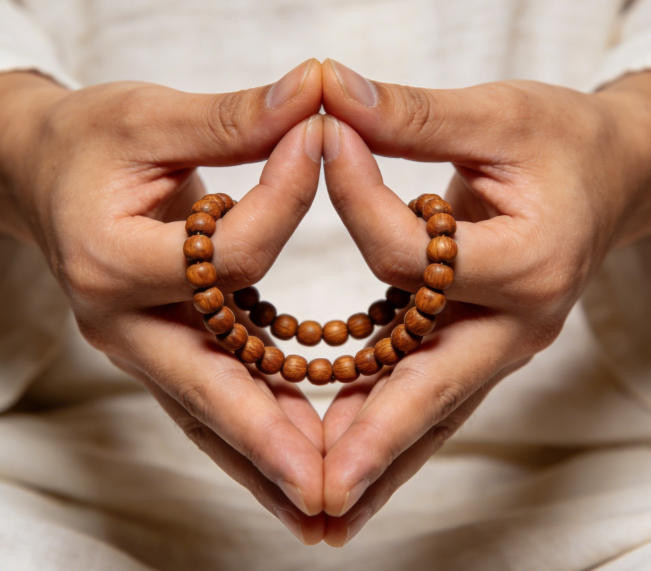
A wrist mala has 18, 21, or 27 beads. It’s designed to wrap around your wrist and be worn throughout the day. You can use it for meditation, but you’ll complete cycles faster.
Both work. The full mala is for dedicated meditation sessions. The wrist mala is for integrating practice into daily life.
The basic technique
- Sit comfortably. You don’t need a special cushion or pose. Sit in a chair if that’s more comfortable. The goal is to be relaxed but alert.
- Hold the mala in your dominant hand. Drape it over your middle finger. Let it hang down on both sides.
- Use your thumb to count. Starting next to the guru bead, use your thumb to pull each bead toward you while saying your mantra (or simply counting breaths).
- Move to the next bead. After each repetition, move to the next bead by pulling it with your thumb.
- Complete the round. Continue until you reach the guru bead again. You’ve now completed one round of 108 (or 18/21/27 for wrist malas).
The guru bead rule
Here’s what most people get wrong: you don’t cross the guru bead.
When you reach the guru bead, you don’t continue around the circle. Instead, you reverse direction. If you were moving clockwise, now move counter-clockwise. The guru bead represents your teacher or the divine — you don’t “step over” it.
This reversal is built into the practice. It keeps you present. You have to pay attention to where you are in the cycle.
What to count
Traditionally, you repeat a mantra with each bead. The most common is “Om Mani Padme Hum” — but you can use any phrase that has meaning for you.
If mantras aren’t your thing, count breaths. Inhale-exhale equals one bead. This is simpler and just as effective.
Some people count gratitudes — one thing they’re grateful for per bead. Some count intentions. The counting is what matters, not what you count.
How long to practice
A full round of 108 beads takes 10-20 minutes depending on your pace. This is a good target for dedicated practice.
With an 18-bead wrist mala, six rounds equals 108. You can do this throughout the day — one round in the morning, one at lunch, etc.
Wearing your mala throughout the day
If you have a wrist mala, wear it on your non-dominant wrist. This keeps it available but out of the way.
Some traditions say to wear it on the left wrist because that side is associated with receiving energy. Others say the right wrist for active energy. Honestly, either is fine. Wear it where it’s comfortable.
When you want to use it, slip it off and hold it in your dominant hand for counting.
Caring for your mala
Don’t get it wet repeatedly — the cord will weaken. Don’t wear it in the shower or while swimming.
If it breaks, it’s not bad luck. It just means the cord wore out. Have it re-strung. The beads are still good.
Some people say malas absorb energy and should be cleansed occasionally. You can do this by leaving it in moonlight, smudging it with sage, or simply holding it with the intention of clearing it. Or don’t — it’s your practice.
The point of all this
The mala isn’t magic. It’s a tool. It gives your mind something to do while you meditate — something repetitive and physical that anchors your attention.
Your mind will wander. That’s normal. When you notice, return to the bead you’re on and continue. The mala helps you notice when you’ve drifted because you stop counting.
That’s it. That’s the practice. Simple, but not easy.