
People ask this a lot, and it’s a reasonable question. You’ve probably seen jade bracelets, obsidian pendants, citrine rings, and a dozen other options — each one claiming to bring luck, wealth, or protection. How are you supposed to pick?
Here’s the honest answer: there’s no single “luckiest” stone. Different stones carry different traditions, different meanings, and work better for different situations. What matters is matching the stone to what you’re actually going for.
This guide cuts through the noise and gives you a practical breakdown of the most commonly used lucky stones, what they’re actually associated with, and who they tend to work best for.
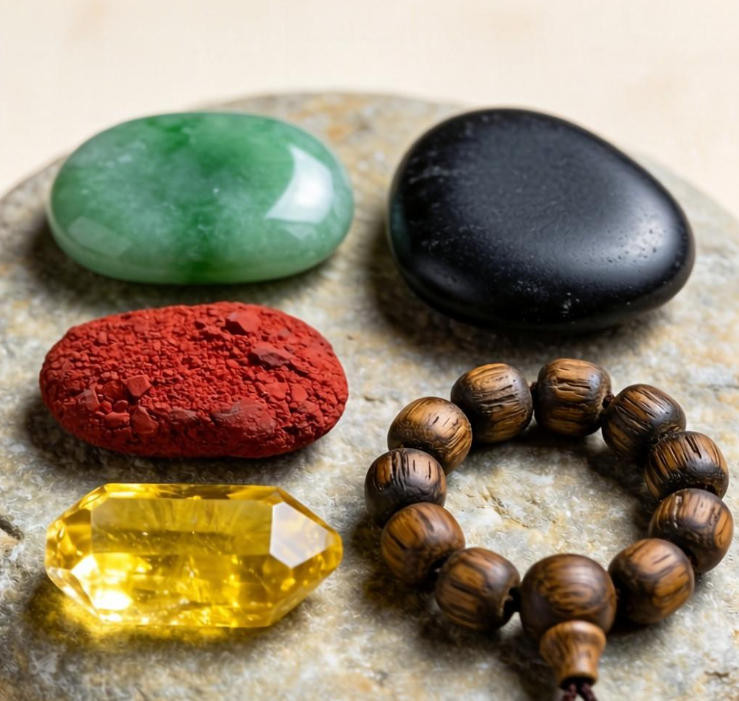
Jade: The one with the longest track record
If you’re looking at stone traditions that go back thousands of years, jade is hard to beat. In Chinese culture, it’s been associated with good fortune, protection, and longevity since at least the Han dynasty. Not metaphorically — people wore jade as literal protective talismans.
The green varieties are the most well-known, but nephrite jade (which includes the Hetian variety from Xinjiang) is considered especially potent in the feng shui tradition. The logic is that the stone absorbs negative energy and acts as a buffer between the wearer and bad luck.
Best for: General protection and long-term luck. Good choice if you want something subtle that works across multiple areas of life — health, relationships, finances.
What to look for: Real jade should feel cold to the touch initially, have slight imperfections when you look closely, and sound clear when tapped. How to tell real jade from fake is worth reading before you buy.
Obsidian: Protection first, luck second
Obsidian shows up a lot in Buddhist and feng shui contexts, but it’s worth being clear about what it actually does. It’s primarily a protective stone — it’s believed to absorb and deflect negative energy rather than actively attract positive things.
Think of it as clearing the path rather than opening a door. If you’re going through a stressful period, dealing with difficult people, or feeling like you keep running into bad luck, obsidian is the stone people traditionally reach for.
The black variety is the most common, but gold sheen obsidian and black obsidian with a six-pointed star pattern (called “snowflake obsidian”) are considered especially effective for wealth protection in Chinese folk tradition.
Best for: Clearing negativity, protection during difficult transitions, shielding from toxic environments.
Not ideal if: You’re looking primarily for something to attract wealth or new opportunities. Obsidian clears — it doesn’t necessarily draw things in.
Red string bracelets with cinnabar: Chinese folk luck
Cinnabar (朱砂, zhūshā in Mandarin) has been used in Chinese folk religion and Taoist practice for centuries. It’s a mercury sulfide mineral with a deep red color, traditionally considered one of the strongest materials for attracting luck and warding off evil spirits.
You’ll see it in Buddha bead bracelets, pendants, and lotus carvings. The red color is significant — red is the color of good fortune in Chinese culture, and cinnabar amplifies that association.
Best for: Wealth luck, protection from negative people, attracting positive relationships. It’s particularly common in Taoist and folk Buddhist traditions rather than Tibetan Buddhism.
Practical note: Cinnabar does contain trace mercury, so most reputable sellers use treated or stabilized cinnabar in their jewelry. It’s perfectly safe to wear. If a seller can’t tell you how their cinnabar was processed, that’s worth asking about.
Citrine: The merchant’s stone
Citrine is the crystal most directly associated with financial luck in Western crystal healing traditions. It’s often called “the merchant’s stone” — old tradition in some European markets was to keep a piece in the cash register.
In feng shui, yellow and gold tones correspond to the earth element and are associated with wealth accumulation. Citrine fits naturally into this framework.
Best for: Attracting money, business success, creative opportunities. If you’re self-employed, starting something new, or in a commission-based job, citrine tends to be the stone people gravitate toward.
Heads up: A lot of citrine on the market is actually heat-treated amethyst. It’s not fake per se, but if you want natural citrine, look for the slightly paler, straw-yellow color rather than deep orange.
Mala beads (108 count): When the material matters less than the practice
Here’s something that gets overlooked: for a lot of people in Buddhist traditions, the luck isn’t in the stone — it’s in the practice. A mala bracelet or full mala necklace made from sandalwood, bodhi seeds, or lotus seeds gets its power from being used in actual meditation and mantra recitation.
The material still matters — different wood and seed types correspond to different Buddhas and intentions — but the stone isn’t the main event.
Best for: People who already have or want to develop a meditation practice. Also good as a gift for someone who practices Buddhism, yoga, or mindfulness.
If you’re new to mala use: How to actually wear a mala for meditation walks through the basics.
The honest answer to “which one is luckiest?”
It’s the one you’ll actually wear, for a reason that makes sense to you.
Stones don’t work like vending machines. The tradition behind all of these — whether it’s Chinese folk religion, Tibetan Buddhism, or feng shui — is that intention matters. Wearing jade because your grandmother told you to carries different weight than picking it because you saw it on social media.
That said, some practical shortcuts:
- Want general protection and have no strong preference? Jade or obsidian.
- Looking to attract more money or new opportunities? Citrine or cinnabar.
- Want something connected to Buddhist practice specifically? Mala beads or a bracelet with a Buddhist deity charm.
- Buying as a gift? Jade is the safest choice — it has the broadest cultural acceptance and a long tradition of being given as a protective gift.
Where to buy
Whatever you decide on, the most important thing is buying from someone who can tell you exactly what the material is. Real jade, authentic cinnabar, natural crystals — these are specific things with specific properties. Generic “crystal bracelets” of unknown origin are a different product.
BuddhaLuck’s collection includes jade bracelets, cinnabar jewelry, obsidian pieces, and Buddhist charm jewelry with sourcing details on each product page. If you have questions about a specific piece — what it’s made of, what it’s traditionally used for — reach out before you buy.
Related reading:
– How to tell real jade from fake
– What does a Buddhist lucky bracelet actually do?
– Obsidian vs Onyx: What’s actually the difference?