
Short answer: obsidian is volcanic glass formed from rapidly cooled lava. Onyx is a type of chalcedony (microcrystalline quartz) formed slowly in volcanic gas cavities. They look similar from a distance but are completely different materials.
Here’s what that actually means if you’re buying jewelry.
What obsidian actually is
Obsidian is volcanic glass. Literally. When lava erupts and cools so fast that minerals don’t have time to crystallize, you get obsidian. It’s glass — natural glass, but still glass.
This matters for a few reasons:
- It’s sharp. Obsidian can be sharpened to a finer edge than surgical steel. This is why it was used for arrowheads and cutting tools for thousands of years. For jewelry, this means obsidian can chip if you hit it hard enough.
- It’s reflective. Obsidian has a glassy, sometimes almost mirror-like surface. It catches light differently than onyx.
- It can be translucent. Hold a thin piece of obsidian up to light and you might see through it slightly. Onyx won’t do this.
Obsidian forms in volcanic regions — the western US, Mexico, Japan, Iceland. Most black obsidian jewelry comes from Mexico or the American Southwest.
What onyx actually is
Onyx is a variety of chalcedony, which is microcrystalline quartz. Unlike obsidian’s glassy structure, onyx has a crystalline structure — just with crystals so small you can’t see them.
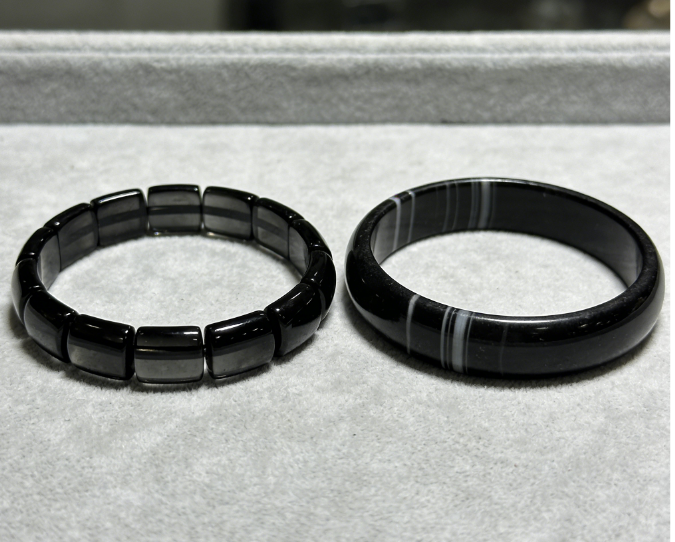
Onyx forms in layers. If you look closely at a piece of onyx, you might see subtle banding — parallel lines of slightly different colors. Black onyx is usually dyed to achieve that solid black color (natural onyx is often banded brown, white, and black).
Key differences from obsidian:
- It’s harder. Onyx is 6.5-7 on the Mohs scale. Obsidian is 5-5.5. Onyx is more durable for daily wear.
- It’s less reflective. Onyx has a more matte, waxy luster compared to obsidian’s glassy shine.
- It won’t chip as easily. The crystalline structure makes onyx tougher than glassy obsidian.
Which one should you choose?
For daily wear bracelets: onyx is probably the better choice. It’s harder, more durable, and less likely to chip if you bump it against things.
For pendants or occasional wear: obsidian is fine. The glassy look is striking. Just be aware it needs slightly more care.
For spiritual/meditation purposes: both have traditional associations. Obsidian is associated with protection and grounding — the idea being that it absorbs negative energy like a black hole. Onyx is associated with strength and self-mastery. Choose based on which meaning resonates with you, not which is “more powerful.”
Price differences
Both are relatively affordable stones. You shouldn’t be paying premium prices for either unless the piece has exceptional craftsmanship or is set in precious metal.
- Simple obsidian bead bracelet: $15-40
- Simple onyx bead bracelet: $20-50
- Either in silver settings: $50-150
If someone is charging $200+ for a basic obsidian bracelet, they’re either selling something else or overcharging.
How to tell them apart
- Look at the surface: Obsidian is glassy and reflective. Onyx is more matte.
- Check for banding: Onyx often has subtle parallel bands. Obsidian is uniform.
- Feel the weight: Obsidian is slightly denser. If you have two same-sized pieces, obsidian will feel heavier.
- Look for chips: If a piece has chipped, obsidian will show conchoidal (curved) fractures like broken glass. Onyx will chip more like other stones.
The bottom line
They’re both legitimate stones. They’re both affordable. The difference matters more for durability and personal preference than for “power” or “energy.” Pick the one you like the look of, understand what you’re buying, and don’t overpay.