
Short answer: it depends on who’s wearing it and why.
That’s not a dodge — it’s actually the most honest thing I can say about this. A Buddhist bracelet means something different to a practicing Buddhist monk, to someone who bought one at a market in Bangkok because it looked interesting, and to someone who was given one by a friend going through a hard time.
None of those three people are wrong.
What Buddhist bracelets were originally for
Traditional mala beads — the original form of what we now call Buddhist bracelets — are counting tools. A full mala has 108 beads. Practitioners use them to count repetitions of a mantra or prayer. Each bead is one repetition. When you complete a full round of 108, you’ve finished one cycle of whatever practice you’re doing.
The wrist mala, which is a shorter version designed to wrap around the wrist, typically has 18, 21, or 27 beads. It’s a condensed version of the same tool, easier to carry and wear daily.
The number 108 is significant in Buddhism and Hinduism for several reasons: 108 defilements in Buddhist cosmology, 108 pressure points in the body according to traditional medicine, 12 months multiplied by 9 planets in Vedic astrology. The specific interpretation varies by tradition, but the number itself is consistent across cultures.
What about the “luck” part?
In Chinese Buddhist tradition, certain symbols and materials carry specific meanings. A obsidian bracelet is associated with protection — the stone’s reflective quality was historically thought to deflect negative energy. Jade is associated with purity and longevity. Sandalwood beads are used in meditation practices and are believed to calm the mind.
These associations aren’t magic claims. They’re cultural and symbolic meanings that have accumulated over hundreds of years of practice. When you wear a jade bracelet, you’re wearing something that millions of people over centuries have associated with good health and calm. Whether that association does anything practical is a question nobody can answer definitively.
What I can say: symbols have psychological weight. Wearing something that represents calm, or protection, or good fortune — if you know what it represents and believe in it — tends to affect how you carry yourself. That’s not mystical. That’s just how humans work.
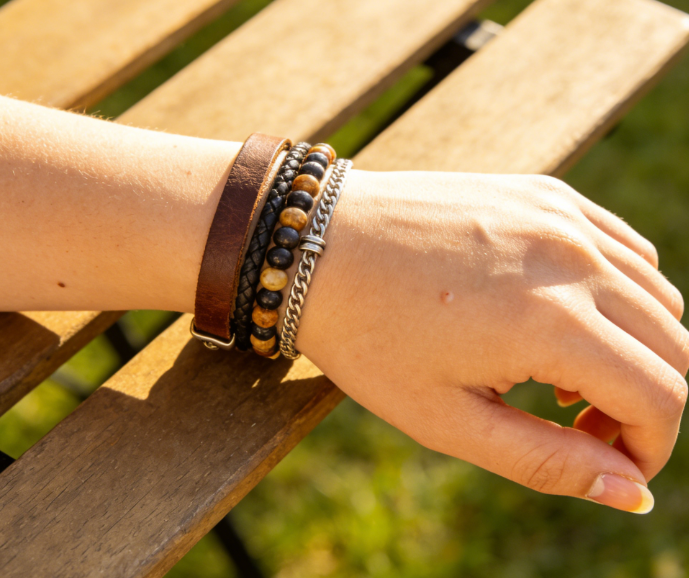
What people actually report
People who wear Buddhist bracelets regularly tend to say a few consistent things. They notice it during the day and use it as a small prompt to pause, breathe, or refocus. It’s a physical reminder of something they care about. Some use it to count breath cycles when stressed. Some just like the feel of the beads.
That’s not a miracle. But it’s not nothing either. A physical object that reliably redirects your attention for two seconds, ten times a day, adds up.
What it’s not
It’s not a guarantee of anything. It won’t change your circumstances. It won’t make bad things stop happening. If you buy one hoping for luck in the way we usually mean luck — random good fortune, specific outcomes — you’ll probably be disappointed.
If you buy one as a daily object that connects you to a set of ideas you find meaningful, it might actually be worth something.